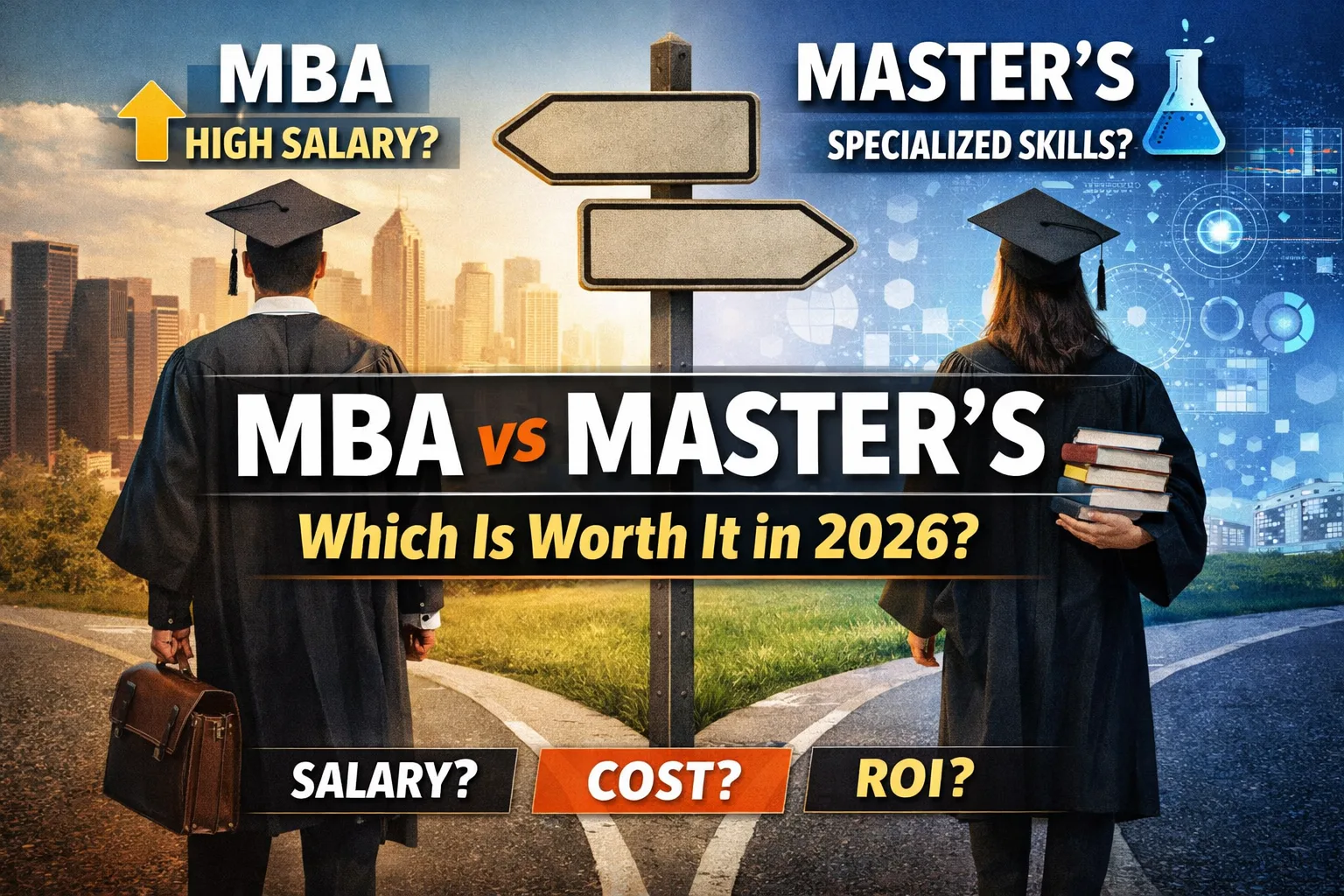
You are standing at one of the most expensive career crossroads of your life. On one side: an MBA that could cost you $200,000 and two years of your time. On the other: a specialised Master’s degree that might cost you nothing if you play your scholarships right.
The question of MBA vs masters degree 2026 is no longer just about prestige. It is about ROI, about AI disrupting traditional business roles, and about whether the degree you choose will still open doors five years from now — or quietly close them.
This guide gives you the honest, data-backed comparison that most articles skip. No MBA programme marketing spin. No generic advice. Just the numbers, the tradeoffs, and a clear decision framework at the end.
[IMAGE: Alt text — MBA vs masters degree 2026 comparison guide featuring two graduates at a crossroads]
Table of Contents
- MBA vs. Master’s Degree — What’s the Actual Difference?
- Salary Outcomes: MBA vs. Master’s in 2026 (By Industry)
- The India Factor: ROI Data No One Talks About
- Cost Comparison — Is an MBA Still Worth the Price Tag?
- AI Disruption: The Question Every MBA Candidate Must Answer
- When to Choose an MBA (And When You Shouldn’t)
- When a Master’s Degree Beats an MBA for Career Growth
- Decision Framework — How to Choose in 3 Steps
- FAQ: MBA vs. Master’s 2026
- Conclusion
MBA vs. Master’s Degree — What’s the Actual Difference?
Most people treat these two degrees as interchangeable. They are not.
An MBA (Master of Business Administration) is a generalist management degree. It teaches you how to lead people, manage organisations, read financial statements, and make strategic decisions. It is deliberately broad. The assumption is that you already have some work experience, and the MBA gives you the frameworks to operate at a higher level across any industry.
A Master’s degree (MSc, MA, MS, MEng, etc.) is a specialist academic qualification. It goes deep on a single discipline — data science, finance, international relations, engineering, public policy. It is built for people who want to become the expert in one domain, not the generalist who manages experts.
Key Structural Differences at a Glance
| Feature | MBA | Master’s Degree |
|---|---|---|
| Focus | Broad management + leadership | Deep specialist knowledge |
| Duration | 1–2 years (full-time) | 1–2 years |
| Work experience required | Usually 2–5 years | Rarely required |
| Cost (top US schools) | $150,000–$230,000 total | $20,000–$80,000 (or fully funded) |
| Networking | Extremely strong alumni networks | More field-specific networks |
| Best for | Career switchers, future leaders | Specialists, researchers, tech roles |
| Entry level | Post-experience professionals | Fresh graduates + professionals |
Understanding this distinction is step one. Because the wrong choice here is not just expensive — it can cost you two years of career momentum.
Salary Outcomes: MBA vs. Master’s in 2026 (By Industry)
Let us get into the numbers, because this is where most comparison articles stay vague.
MBA Salary Data (2025–2026)
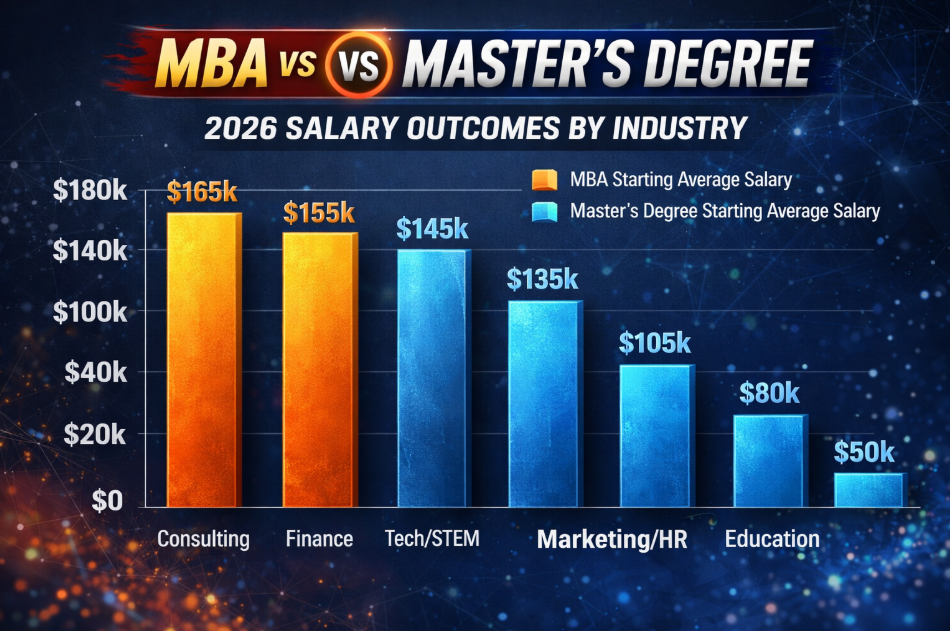
The GMAC 2025 Corporate Recruiters Survey projects the median starting salary for MBA graduates in the US at $125,000 in 2025 — up $5,000 from the year prior.
At elite schools, the numbers are significantly higher:
- Stanford GSB: $187,504 average starting salary (Class of 2024)
- Top 10 MBA programmes overall: $170,220 average starting salary
- Harvard, Wharton, MIT alumni: Median earnings of $245,000–$260,000 just three years after graduation, according to Fortune
According to data compiled by Coursera’s MBA Salary 2026 Guide, MBA graduates can expect a 119% salary increase within three years of earning their degree, according to GMAC.
Master’s Degree Salary Data (2025–2026)
Master’s degree holders in the US earn a median annual salary of around $90,324, compared to roughly $77,636 for bachelor’s degree holders — a meaningful but different premium.
However, this average masks huge variation by field:
- STEM Master’s (Computer Science, Data Science, AI): $110,000–$145,000 starting
- Master’s in Finance (non-MBA): $85,000–$120,000
- Master’s in Marketing or HR: $55,000–$75,000
- Master’s in Engineering: $90,000–$130,000
- Master’s in Education or Social Work: $40,000–$55,000
The Honest MBA vs MSc Salary Summary
If you graduate from a top-20 MBA programme, you will almost certainly out-earn a Master’s degree holder at the start. No question.
But if you pursue a fully funded STEM Master’s from a strong university, you may enter the job market debt-free — and a Data Science MSc from a top school can land $120,000+ starting salaries. When you factor in zero student debt versus $200,000 in loans, the real ROI picture shifts dramatically.
[IMAGE: Alt text — bar chart comparing MBA vs masters degree 2026 salary outcomes by industry]
The India Factor: ROI Data No One Talks About
India is the largest single market of graduate business education seekers globally. Yet almost no comparison article addresses the India-specific salary reality.
Here is the honest data for 2025:
IIM Placements (Top-Tier MBA in India)
- IIM Ahmedabad: Average package ₹35.5 LPA, highest ₹1.15 crore
- IIM Bangalore: Average ₹34.88 LPA
- IIM Calcutta: Comparable, with highest packages reaching ₹1.45 crore
- IIM Lucknow: Average ₹32.3 LPA, highest ₹75 LPA
- Newer IIMs (Nagpur, Trichy, etc.): Average ₹13–₹21 LPA
The fees at older IIMs sit around ₹24–₹27 lakh. With average placements exceeding ₹32 LPA, ROI breakeven typically happens within one to two years for top IIM graduates.
What About Other MBA Colleges in India?
Outside the IIM ecosystem, the reality is starker:
- Tier 2 B-schools (NMIMS, IMT, Great Lakes): ₹10–₹18 LPA average
- Tier 3 colleges: ₹6–₹10 LPA — and some students struggle to get placed at all
If you are not getting into an IIM, ISB, or XLRI, you need to ask yourself whether a ₹15–₹20 lakh MBA investment justifies a ₹8–₹10 LPA starting salary. In many cases, it does not.
The Master’s Alternative for Indian Students
A fully funded Master’s abroad — through DAAD, Erasmus+, Chevening, or Commonwealth scholarships — can cost ₹0 in tuition while placing you in a global job market at $80,000–$110,000 starting salaries. This is a path far fewer Indian students consider, but it is one of the highest-ROI routes available.
You can explore fully funded international scholarships on The Scholarship Project to find real options matched to your profile.
Cost Comparison — Is an MBA Still Worth the Price Tag?
This is the section MBA programme websites do not want you to read carefully.
Full Cost of a Top MBA in 2026
At a top US business school, the total cost of attendance (tuition + living expenses + opportunity cost of not working) can exceed $300,000 over two years once you factor in foregone salary.
- Harvard Business School: ~$230,000 tuition alone (2025–26)
- Wharton (UPenn): ~$225,000 tuition
- Kellogg (Northwestern): ~$220,000 tuition
- Mid-ranked US MBA programmes: $80,000–$130,000
Full Cost of a Master’s Degree in 2026
Master’s degrees offer far more range:
- Fully funded (DAAD, Erasmus+, Chevening, NSF): $0 tuition, with living stipend
- UK Master’s (1 year): £15,000–£35,000 total
- EU Master’s programmes: €3,000–€15,000
- US STEM Master’s: $30,000–$80,000 (many with assistantships)
- Online Master’s (US public universities): $10,000–$25,000
The opportunity cost calculation is also different. A one-year Master’s means one year out of the workforce. A two-year MBA means two years — plus often a 30–50% salary cut during the programme.
Simple ROI Comparison
Assuming you take on $200,000 in MBA debt at 7% interest, and your salary jumps from $75,000 to $125,000 after graduation, your net gain in year one is about $50,000 — and it takes roughly four to five years just to break even before interest. That math works comfortably if you land a consulting or finance role. It gets painful if you do not.
A debt-free Master’s that lifts your salary from $65,000 to $100,000 creates immediate positive ROI from day one.
AI Disruption: The Question Every MBA Candidate Must Answer in 2026
Here is the angle no other comparison article covers — and it may be the most important consideration of all.
What AI Is Actually Doing to MBA Career Tracks
The traditional MBA pipeline has three destinations: management consulting, investment banking, and general management. All three are being reshaped by AI right now.
According to research cited in McKinsey’s 2025 AI State report, AI is already automating tasks that once formed the backbone of junior analyst roles — data synthesis, slide creation, financial modelling templates, market research.
Firms like BCG are reportedly hiring fewer MBA graduates while prioritising data scientists and AI specialists. The “people-intensive pyramid model” that consulting firms have relied on — armies of junior MBAs doing analytical grunt work — is being directly challenged.
The share of Harvard MBA students receiving no job offer within three months of graduation climbed from 4% in 2021 to 15% by 2024. MIT saw almost identical numbers.
Does This Mean MBA Is Dead?
No. But it means the value proposition has shifted.
An MBA from a top-15 global school still buys you something AI cannot replicate: a network, a brand signal, and access to senior leadership tracks. What is changing is that mid-ranked MBA graduates in non-leadership roles are the most exposed to displacement.
The new rule: an MBA is worth it at the top, and risky in the middle.
What About Master’s Degrees and AI?
Specialist Master’s degrees — particularly in AI, data science, machine learning, and computational fields — are positioned on the supply side of the AI economy, not the demand side. These graduates are building the tools, not being disrupted by them.
A Master’s in AI or Data Science from a strong technical university may be the single highest-ROI graduate degree available in 2026.
When to Choose an MBA (And When You Shouldn’t)
This is the honest answer to “should I do an MBA” — without the sales pitch.
Choose an MBA if:
- You want to switch industries completely (e.g., from engineering to consulting, or from medicine to finance)
- You are targeting C-suite or senior leadership roles within the next 10 years
- You have been admitted to a top-15 global programme (where brand, network, and recruiter access justify the cost)
- You need the MBA network to access markets or industries that are otherwise closed to you
- You are in a role where the MBA credential is still a gate (strategy consulting, private equity, certain investment banking roles)
- You have strong work experience (3–7 years) to leverage during the programme
Do NOT choose an MBA if:
- You are under 25 with no work experience — most top programmes will not accept you, and you will get far less from the experience
- You want a technical or research career — an MBA adds little here
- You are looking at a mid-ranked or lower-ranked programme with mediocre placement outcomes
- You are going for the wrong reason: “to take a break,” “because my company told me to,” or “because it sounds impressive”
- The ROI does not work on paper — run the numbers honestly before committing
When a Master’s Degree Beats an MBA for Career Growth
The question “is a Master’s degree worth it in 2026?” is increasingly being answered with a clear yes — in the right fields.
Masters Degree Wins Clearly In:
Technology and AI-adjacent roles A Master’s in Computer Science, Data Science, or AI from a target university places you directly into a $100,000–$145,000 starting role. No MBA can compete here for pure technical hiring.
Research and academia If a PhD or research career is in your future, a specialist Master’s is the necessary stepping stone.
Government, policy, and international development An MPA (Master’s in Public Administration) or MPP (Master’s in Public Policy) is far more valued in this sector than an MBA.
Healthcare management A Master’s in Health Administration (MHA) or Biomedical Science is typically preferred over an MBA for clinical-adjacent leadership roles.
Early career without work experience If you are 22–24 and want graduate-level credentials now, a Master’s is almost always the right move. Build experience, then consider an MBA later if needed.
Cost-sensitive candidates If you qualify for fully funded programmes like DAAD scholarships, Chevening, Erasmus+, or Commonwealth, a Master’s abroad can cost you nothing. That changes the entire ROI equation.
Explore study abroad funding opportunities at The Scholarship Project — there are more fully funded Master’s options than most candidates realise.

Decision Framework — How to Choose Between MBA and Master’s in 3 Steps
This is the structured decision tree that helps you cut through the noise. Use it as a genuine filter, not just a reading exercise.
Step 1: Where do you want to be in 10 years?
- If the answer involves a C-suite title, general management, or building a company → lean toward MBA (from a target school)
- If the answer involves deep expertise, technical leadership, research, or a specific industry → lean toward Master’s
Step 2: What does the ROI calculation actually look like for you?
Run this formula honestly:
Post-degree salary increase (annual) × Years to retirement minus Total cost of degree (tuition + living + lost income) = Your real ROI
- If the MBA ROI is positive within 5 years, proceed
- If the ROI takes longer than 7 years to break even, reconsider — especially at mid-ranked schools
For Indian students specifically: If you are not getting into IIM A/B/C, ISB, or XLRI, a fully funded Master’s abroad often produces better ROI than a Tier 2 MBA.
Step 3: Is the school brand doing meaningful work for you?
An MBA from a school no one has heard of is not an MBA in any meaningful career sense. School brand matters enormously in this degree type. If the brand is not top-tier, the Master’s (especially from a strong public or international university) almost always wins.
Quick Decision Summary:
- Top-15 MBA school + 3+ years experience + switching industries = MBA
- Any other scenario for tech, research, or budget-conscious candidates = Master’s first, MBA later (if needed)
Frequently Asked Questions
Which pays more — an MBA or a Master’s degree in 2026?
An MBA from a top programme typically produces higher starting salaries, with median earnings around $125,000 in the US versus roughly $90,000 for general Master’s degree holders. However, a STEM Master’s in fields like data science or AI can reach $120,000–$145,000 starting — often with no debt — which makes the real-world ROI comparison very close. For Indian students, an IIM MBA produces the highest domestic salaries, while a fully funded Master’s abroad often offers superior global earning potential.
Can I do an MBA without work experience in 2026?
Most top MBA programmes require a minimum of 2–3 years of work experience, with the average intake having 4–6 years. Some schools offer deferred enrolment for exceptional undergraduates (Harvard 2+2, Stanford Deferred, Columbia 3-2-1). Without work experience, a specialised Master’s degree is almost always the better starting point — both for admissions success and for maximising what you get out of the programme.
Is an online MBA worth it in 2026?
An online MBA can be worth it in specific circumstances: if it is from a highly ranked programme (Wharton Online, Illinois iMBA, Indiana Kelley), if you are paying significantly less than for the full-time equivalent, and if your career goals do not require on-campus recruiting. For careers that depend heavily on network and in-person recruiter access — consulting, investment banking, private equity — an online MBA from a non-elite school rarely replaces the full-time equivalent.
Which is better for a tech career — MBA or Master’s?
For technical roles (software engineer, data scientist, ML engineer, product engineer), a specialist Master’s degree in a relevant field is almost always superior. For product management, strategy, or VC-facing roles in tech, a top MBA has strong placement into companies like Google, Microsoft, and Amazon. In 2026, the most valuable profile in tech is someone with a strong technical Master’s plus MBA-level business fluency — increasingly achievable through shorter executive education programmes.
What are the best MBA vs Master’s options for Indian students in 2026?
For Indian students, the decision breaks down clearly: if you can get into IIM A, B, or C, or ISB Hyderabad, the MBA ROI is exceptional (average packages ₹32–₹35 LPA on fees of ₹24–₹27 lakh). If you cannot crack those programmes, a fully funded Master’s abroad through scholarships — DAAD for Germany, Chevening for the UK, Erasmus Mundus for Europe — often delivers better ROI. You leave debt-free, with global exposure and a starting salary in foreign currency. You can find the latest scholarship opportunities for Indian students at The Scholarship Project.
Conclusion: MBA vs Masters Degree 2026 — The Honest Answer
Here is the bottom line on MBA vs masters degree 2026: there is no universal winner. There is only the right answer for your situation, your goals, and your finances.
If you are targeting senior leadership, switching industries, and have admission to a top-15 programme — the MBA still delivers. The network, the brand signal, and the salary premium at elite schools remain real and documented.
If you are earlier in your career, working in tech or a specialist field, budget-conscious, or targeting roles where deep expertise matters more than general management — a specialist Master’s degree is the stronger, often far cheaper, higher-ROI choice in 2026.
The one thing both paths require: intentionality. The students who get the most out of either degree are the ones who arrived with a clear purpose, not because it was the next logical step.
Whichever path you choose, start with the funding options. Hundreds of thousands of rupees — or dollars — in scholarships are available to the candidates who look for them.
Explore fully funded opportunities for your graduate journey at The Scholarship Project — from free Master’s programmes abroad to funded MBA pathways and high-income career development resources.
